Meta-Learning for Adaptive Control with Automated Mirror Descent
Abstract
Abstract. Adaptive controllers guarantee stability by learning unknown parameters online, but their performance hinges on hand-designed features and Euclidean adaptation laws. We propose MALC-PX4, a meta-learning framework that simultaneously infers disturbance-aware features and the mirror-descent geometry used by the adaptive law. Offline, we solve a differentiable bi-level program over ensembles of wind scenarios to identify the feature network, controller gains, and Bregman divergence parameter that maximize reference-tracking accuracy. Online, the learned mirror-descent controller updates parameters with implicit regularization aligned to the disturbance family, yielding provable convergence to a compact tracking set and exact tracking when the learned features are accurate. Planar quadrotor experiments under strong crosswinds cut the RMS tracking error by over 50% compared to gradient-descent adaptive baselines and generalize to wind speeds well beyond the meta-training range.
Automated Mirror-Descent Adaptation
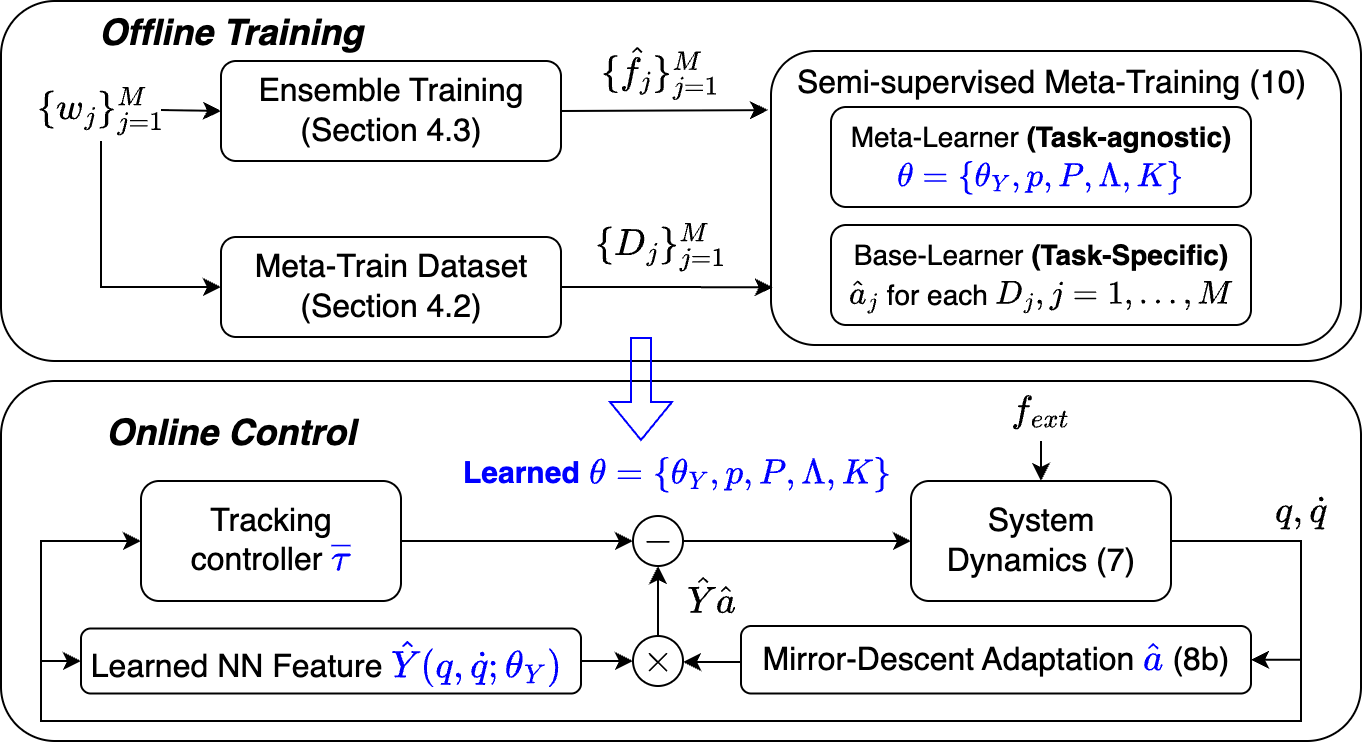
We recast adaptive control as a bi-level meta-learning problem in which each wind profile defines a separate task. The base learner is a mirror-descent adaptive controller for the manipulator dynamics, initialized with sliding variables $s = \dot{\tilde{q}} + \Lambda \tilde{q}$ and control input $u = \tau(q, \dot{q}) - \hat{Y}(q, \dot{q}; \theta_Y)\hat{a}$. Its update leverages the Bregman divergence $\phi(a) = \lVert a \rVert_p^p$, allowing us to depart from the Euclidean geometry recovered when $p = 2$.
The meta learner optimizes the feature network parameters $\theta_Y$, controller gains $(P, K, \Lambda)$, and the geometry parameter $p$ so that closed-loop trajectories minimize reference-tracking loss across tasks. Because the true disturbance model is unavailable offline, we fit an ensemble of neural surrogates for the wind-induced drag and unroll them inside a differentiable simulator when computing task losses.
Jointly searching over representation and geometry lets the controller implicitly regularize parameter updates in a way that matches the underlying disturbance family, yielding faster convergence and tighter Lyapunov certificates than gradient-descent adaptation alone. Theorem 2 in the paper shows that the resulting closed-loop error converges to a compact set proportional to the feature approximation error, and collapses to zero when the learned features are exact.
Planar Quadrotor Experiments
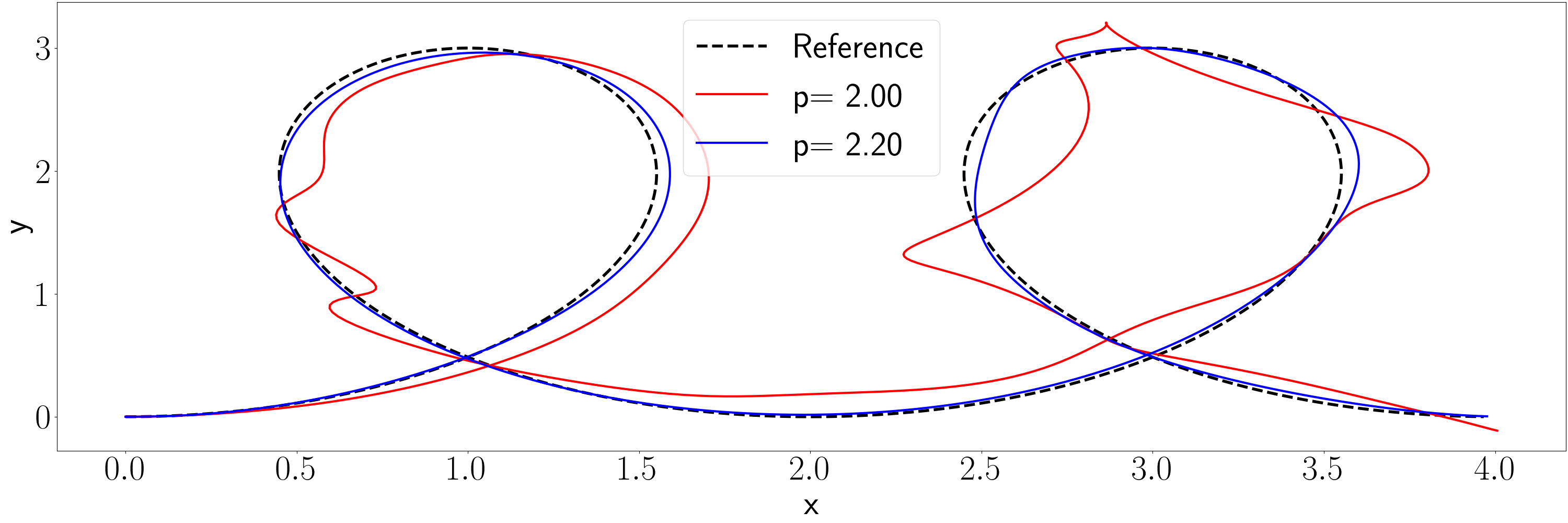
We evaluate the learned controller on a fully actuated planar quadrotor subject to crosswinds modeled as quadratic drag with coefficients $(\beta_1, \beta_2) = (0.1, 1.0)$. Tasks arise by sampling wind speeds $w \in [0, 6]$ m/s from a scaled beta distribution and synthesizing random reference loops in the $x$-$y$ plane. Meta-training learns $p \approx 2.2$, signaling a preference for slightly heavier-tailed geometry than the Euclidean baseline $(p = 2.0)$.
At test time we push the controller far beyond the training distribution, up to 10 m/s winds. The table summarizes the root-mean-squared tracking error over a 10 s double-loop trajectory:
| Wind speed (m/s) | RMS, GD baseline (p = 2.0) | RMS, ours (p = 2.2) |
|---|---|---|
| 2.0 | 0.0171 | 0.0095 |
| 4.0 | 0.0443 | 0.0172 |
| 6.0 | 0.0910 | 0.0303 |
| 8.0 | 0.1738 | 0.0483 |
| 10.0 | 0.2746 | 0.0714 |
The mirror-descent controller halves the tracking error within distribution and delivers even larger gains out of distribution. Figure 2 shows that the learned geometry keeps the roll angle and lateral position on track even after multiple loops, whereas the gradient-descent baseline diverges once the crosswind intensifies.
BibTeX
@inproceedings{tang2025meta,
  title = {Meta-Learning for Adaptive Control with Automated Mirror Descent},
  author = {Tang, Sunbochen and Sun, Haoyuan and Azizan, Navid},
  booktitle = {Proceedings of the Learning for Dynamics and Control Conference},
  year = {2025},
  url = {https://arxiv.org/abs/2407.20165}
}